Daily Digest
Today's news, read the way the exam rewards it
The single most exam-relevant story from every subject, then the full edition: every issue filtered for relevance, broken down the way an answer needs it, and connected back to the syllabus and previous-year questions.
Top Stories in Today’s Brief are free. GS I–IV papers need an account and a subscription.
Relevance over volume
Analysis over summary
Recall over memorizing
Structured, not scattered
Built for the UPSC syllabus
How it works
The Tattva learning flow
 01Step 1View details
Current Affair
Every entry starts with what actually happened — a concise, factual account of the event, drawn from the day's news.

- 02Step 2View details
Relevance
Not everything in the news deserves your time. Each issue is scored against UPSC syllabus alignment and PYQ patterns before it reaches you.

- 03Step 3View details
Analysis
Understand the background, key concepts, and implications behind the issue — economic, governance, social, or environmental.

Built for how you study
Keep the sources you trust. Add clarity to what you learn from them.
Tattva isn't a news platform. It's a current-affairs learning platform.
Your sources
- Newspapers
- YouTube
- Telegram
- PDFs
- Magazines
Tattva
- Relevance
- Context
- Connections
- Learning
Your preparation
What's inside
A real edition, not a headline feed


Top Stories first
The strongest story in each subject, from Polity and Economy to Science & Tech and Security, strongest first.

Full analysis, not just news
What happened, why it matters, the background you need, key concepts, and the implications — the thinking already done for you.

Mapped to the exam
Every story tagged to its GS paper, a Prelims fact, a Mains angle, and — where a genuine match exists — the previous-year question it connects to.

Read it your way
Read the Top Stories, or the edition one GS paper at a time, from GS-I to GS-IV.
Read it in Hindi
Switch the Digest to Hindi from the bar at the top of the page. Exam terms show their Hindi or English meaning on hover. Article text stays in English for now.
Make it yours
Bookmark stories, highlight lines and keep notes as you read. Your notes collect in your workspace.
From the news to the exam
How Tattva connects current affairs to UPSC
Know what matters
Not everything deserves the same attention.
Tattva helps you identify the developments worth learning from.
- FM Sitharaman calls for open, predictable global economic ties amid rising uncertainty (Worth learning from)
- The tussle for top posts in India’s CAPFs: IPS officers or force veterans? (Worth learning from)
- From pharmacy to laboratory: India's leap into drug discovery (Worth learning from)
- Government Adds 28 Strategic Ladakh Locations To Survey of India Maps, Including Key LAC Friction Points and High-Altitude Passes
- Why Allahabad High Court said hookah service is banned in designated smoking areas
- We seem to be learning that currency depreciation is not always bad: Panagariya
- Nestle India’s ‘low-fat dairy whitener’ found ‘unsafe, substandard’ at Hotel Lalit: FSSAI
- SCI Will Steer India's Push To Become A Top Shipbuilding Nation, Says Sonowal As PSU Turns 65
- Lung cancer is India’s deadliest cancer. So why don’t we screen for it?
- UAE Attorney General Confirms Flydubai Co-Pilot Attacked Captain With Cockpit Axe, Calls It 'Terrorist Act'
- India Achieves First 5.56-Km Free-Space QKD Link In Major Quantum-Secure Communication Trial
- Russia Voices Concerns Over Civilian Deaths In Pakistani Strikes On Afghanistan, Calls Situation ‘Serious’
Worth learning from. Twelve stories from one day's edition. Three get the emphasis.
Know why it matters
See how one story connects to the exam.
- NewsPM urges Indian pharma to aim for the global top five
- IssueFrom generic medicines to novel drug discovery
- Concept
- Biopharma Shakti Mission
- CRDMO
- Syllabus
- GS III
- Prelims GS I
- Essay
- PYQGS III · 2020 Discuss the challenges and opportunities faced by the Indian pharmaceutical industry in moving from generic drug manufacturing to novel drug discovery.
Know what to learn
From an article to a learning brief.
The news
From pharmacy to laboratory: India's leap into drug discovery
In his Independence Day address, Prime Minister Narendra Modi urged Indian pharmaceutical firms to aim for a place among the world’s top five, signalling a policy push for the sector to move beyond generic medicines toward novel drug discovery and development.
What to take away
- ContextWhat happened, and why should you care?
- India’s pharmaceutical sector is the world’s third‑largest by volume, with more than 3,000 companies and 10,500 manufacturing units, yet it is only the 11th by value, reflecting a dominance of low‑margin generics.
- ConceptsWhat do you need to understand?
- Biopharma Shakti Mission
- CRDMO
- AI-driven drug discovery
- Viksit Bharat@2047
- UPSC connectionWhere does it fit?
- GS III
- Prelims GS I
- Essay
- GS II
- QuestionsHow might you think about it?
- Funding allocation vs. fiscal prudence
- Regulatory speed vs. safety and efficacy assurance
- Start‑up promotion vs. incumbent generic industry stability
- AI investment vs. wet‑lab infrastructure development
Why this approach
Here's what changes
FromMore sources
ToMore clarity
FromMore headlines
ToClearer priorities
FromReading
ToUnderstanding
FromNews consumption
ToUPSC learning
From“Is this important?”
To“I know why this matters.”
From“Did I miss something?”
To“I know what I've covered.”
In the product
See the difference between reading the news and learning from it.
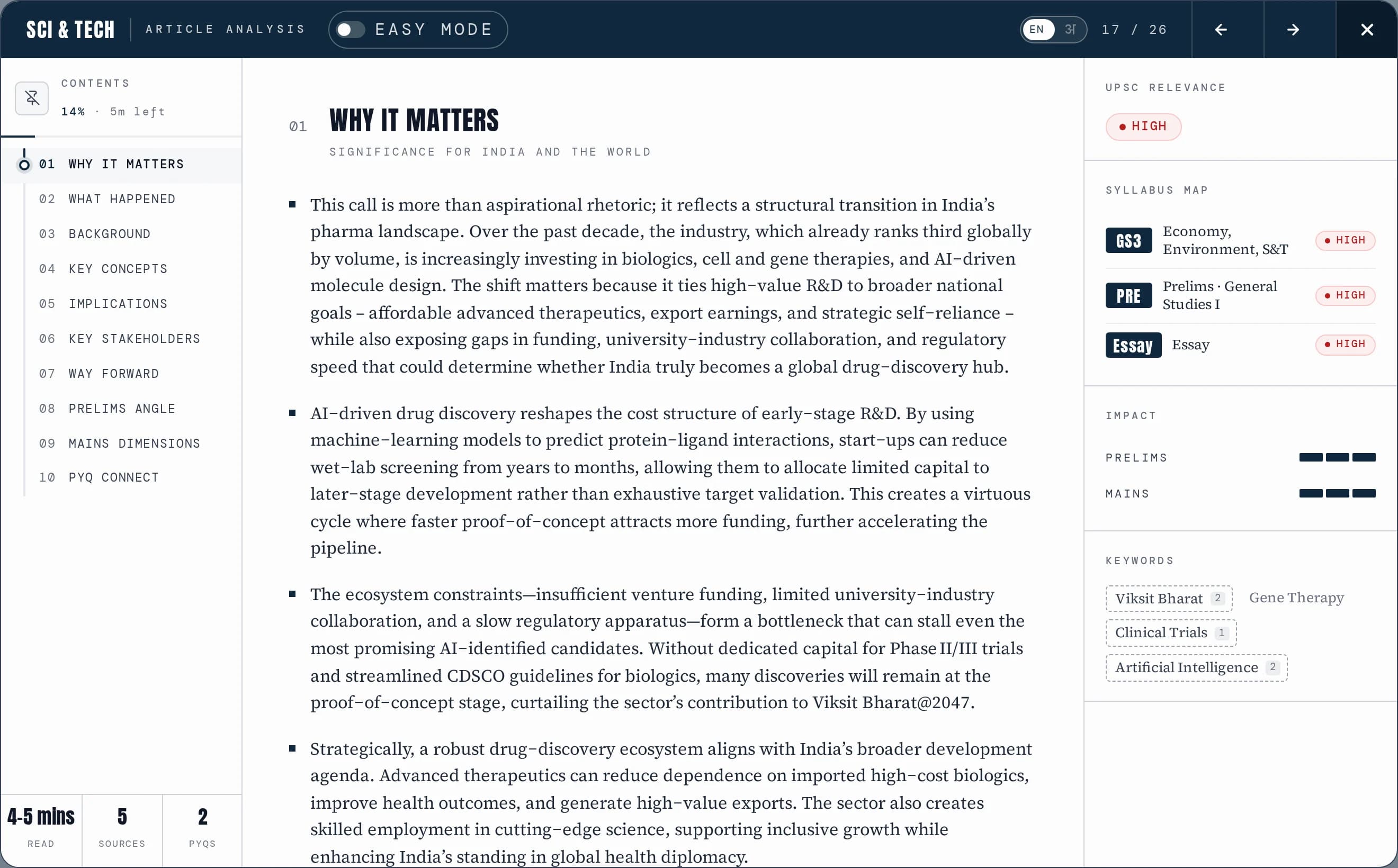
- Why it mattersrelevance
- Syllabus connectionwhere it fits
- PYQ connectionwhat it connects to
- What to learnthe actual takeaway
The real analysis of the story above, as it appears in the reader.

FAQ
Common questions from aspirants
A current-affairs learning platform, not a news platform. Tattva turns daily news into structured, exam-oriented knowledge for UPSC and other competitive exams — connecting each issue to relevance, analysis, the paper it belongs to, and previous-year questions.
Every issue is scored against UPSC syllabus alignment, previous-year question patterns, and its constitutional, economic, social, or long-term importance — so you see what actually matters for the exam, not just what's trending.
Beyond what happened: why it matters, the background you need, key concepts, implications, and the exam perspective — the same questions you'd otherwise have to work out yourself.
Only where a genuine connection exists. Tattva doesn't force a PYQ link onto an issue just to have one — if there's no meaningful match, that's stated clearly instead.
Every relevant issue is tagged to the GS papers it touches — including where one issue spans more than one paper — and organized by topic and sub-topic so it's easy to revise by subject.
Keep it. Tattva doesn't replace your sources. It adds relevance and structure to what you learn from them.
No. It shows why a development matters and where it connects to the syllabus and past questions. It makes no prediction.
Yes. The Digest can be switched to Hindi from the bar at the top of the page. The interface and exam terms are translated; article text and analysis are in English for now.




You don't need another source. You need to know what to do with the information you already have.
See what matters. Understand why. Learn what to take forward.